Why I Write
George Orwell arrived at his political convictions relatively late and died young, at just 46. Yet few writers did more to shape political writing in the 20th century. If the title of “best political writer” belongs not to the one who wrote most about politics, but to the one who lodged political ideas deepest in ordinary language, Orwell has one of the strongest claims.
මෙච්චර කාලයකට ගුරුවරයෙක් ගෙන් කෙනෙක් ගෙන් මනුස්සයෙක් ගෙන් අහපු හොඳම වචන ටික. කවදාවත් අපිට එක දැනෙන්නවත් දීලා නෑ...ඒක වගකීමෙන් කියන්නේ
Say Orwellian and people immediately understand. Say Big Brother and almost anyone knows you mean surveillance and state intrusion. Orwell gave us a vocabulary for political oppression: doublethink, thoughtcrime, newspeak, memory hole. Even the first coinage of the term "Cold War" is usually attributed to him. The term first appeared in the essay “You and the Atom Bomb,” written and published shortly after the Hiroshima and Nagasaki bombings. The piece appeared in the British newspaper Tribune on October 19, 1945—just over two months after the August 1945 attacks..
Most writers are fortunate to produce one book that outlasts them. Orwell left behind a collection of concepts people still use, and misuse, to think about politics and power.
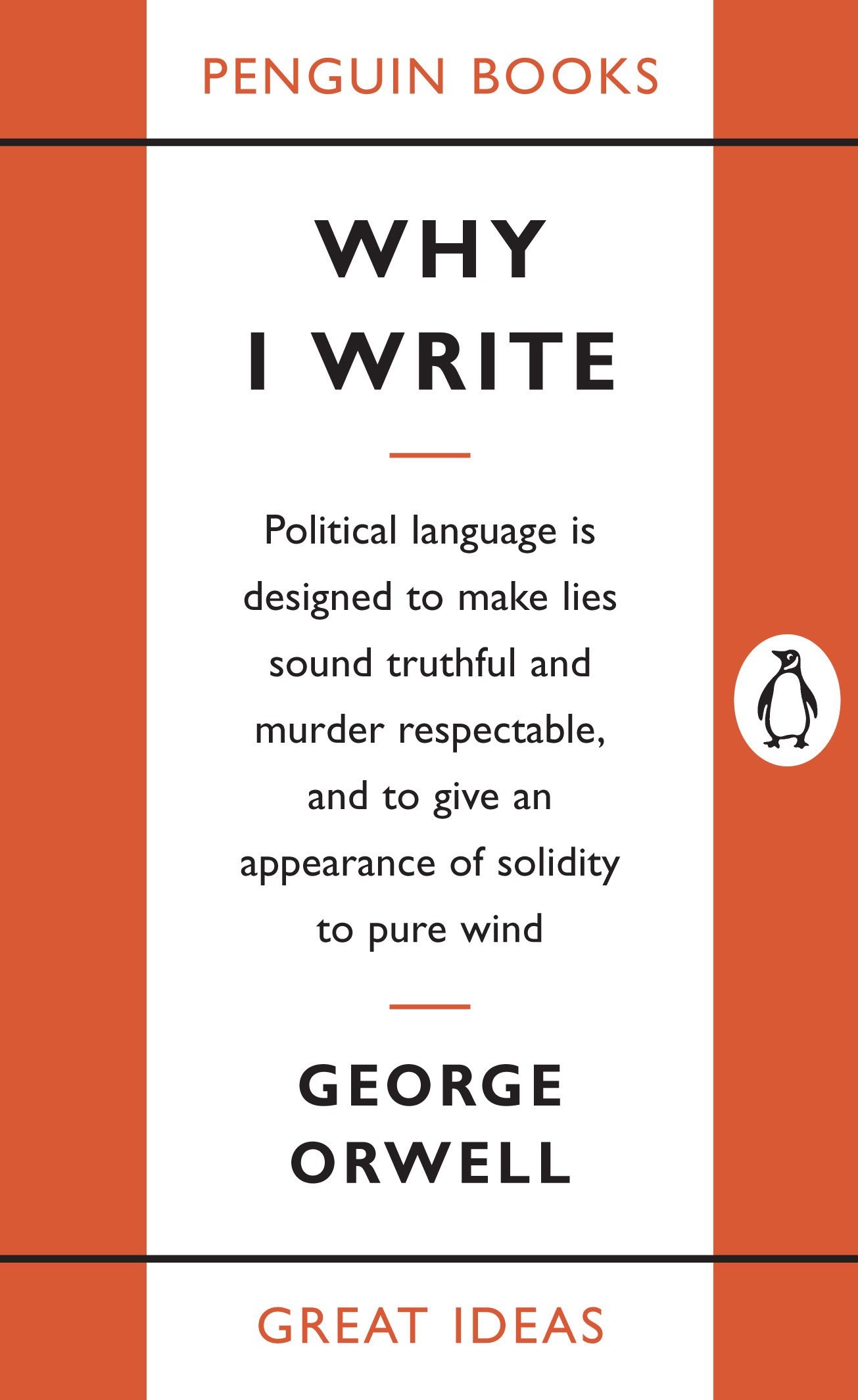
Book Cover from Penguin Books
This short Penguin collection contains four essays. Together they show both what writing meant to Orwell and how he did it..
- Why I Write is the most autobiographical. Orwell lays out four motives for writing: sheer egoism, aesthetic enthusiasm, historical impulse, and political purpose. The essay is famous partly because of how cleanly it explains his own development. At the end, he says that when he lacked political purpose, he fell into “purple passages” and “humbug generally.” That sentence alone explains a lot about his later style.
- The Lion and the Unicorn is an example of a form that has mostly disappeared: the pamphlet essay. It is longer than an article and shorter than a book. Orwell uses it to defend a certain idea of Englishness, argue for democratic socialism, and sketch the revolution he thought wartime Britain required. It is one of the best examples of his ability to combine patriotism, class analysis, and plain prose. This might also help you understand why the British kicked out Churchill immediately after the 2nd World War.
- A Hanging is different from the others. It is usually classified as narrative nonfiction, but it reads like a short story. It has scene, movement, and climax. Orwell barely comments. You are left with as many questions as answers.
- Politics and the English Language is the most practical essay in the collection. It works both as a political argument and as a style guide. The political claim is that bad language makes bad thought easier. The practical claim is that most bad writing can be improved by saying what you actually mean in the simplest words possible. Orwell’s six rules are famous because they are mostly common sense, and because so few people follow them..
If you are curious beyond this book (like I was after reading the book), you might find the following useful
-
Ryan Chapman’s YouTube video titled What Orwell Personally Believed tries to trace Orwell’s intellectual development and the convictions behind his writing. Chapman has several great YouTube primers on imoportant ideas in political science, including socialism, fascism, and post-modernism.
-
Christopher Hitchens’s Why Orwell Matters makes a different case. Hitchens argues that Orwell was unusual not because he built a grand theory, but because he was willing to see unpleasant facts clearly. In Hitchens’s telling, Orwell was the only major intellectual of his time who opposed the three great threats of the 20th century without making excuses for any of them: imperialism, fascism, and Stalinism There is a 2005 talk by Hitchens on the book, where he explicitly details these three points and defends Orwell's legacy against critics..
-
One of the best examples of this was Orwell’s defense of P.G. Wodehouse, who was his polar opposite. Wodehouse wrote comic masterpieces about idle aristocrats, country houses, and trivial disasters. Orwell spent much of his life attacking the class world Wodehouse treated as comic material. Yet when Wodehouse was denounced after the Berlin broadcasts of 1941, Orwell defended him.
The facts made Wodehouse look terrible. Captured by the Germans in France, he later made a series of radio broadcasts from Berlin aimed at American listeners. They were not Nazi propaganda in substance. They were mostly comic accounts of internment. But the optics were disastrous. Britain was at war. London was being bombed. Broadcasting from enemy territory, however foolishly, looked unforgivable..
The British press treated him as a traitor. Orwell thought this was dishonest. In his essay In Defence of P.G. Wodehouse, he argued that Wodehouse was not a fascist but an apolitical and outdated man who simply did not understand the world he was living in. More importantly, Orwell saw that Wodehouse had become a convenient scapegoat. It was easier to rage at a comic novelist than to confront the failures and evasions of the British establishment itself.
“What I have most wanted to do throughout the past ten years is to make political writing into an art. My starting point is always a feeling of partisanship, a sense of injustice. When I sit down to write a book, I do not say to myself, ‘I am going to produce a work of art’. I write it because there is some lie that I want to expose, some fact to which I want to draw attention, and my initial concern is to get a hearing. But I could not do the work of writing a book, or even a long magazine article, if it were not also an aesthetic experience”
~ George Orwell, Why I Write